2026 Top Vacuum Bags for Clothes with Electric Pump
Choosing the right Vacuum Bags For Clothes With Electric Pump can make limited storage feel surprisingly generous. A winter coat that fills half a closet may compress into a firm, flat bundle under the bed. Still, compact does not always mean better.
This 2026 guide examines leading options through practical storage tests, not attractive product claims alone. We consider pump strength, valve design, zipper reliability, plastic thickness, and everyday handling. Each bag should remove air evenly without forcing delicate wool, padded jackets, or leather items into damaging shapes. We also check whether the electric pump overheats after several bags and whether the seal remains tight overnight.
Small details matter.
Andrew Mellen, a professional organizer and author, says, “The best organizing system is the one you will use.” That principle applies here. A powerful pump is useful, but a complicated bag may remain unused in a crowded cupboard. The best choice should be simple enough for weekly packing and dependable enough for seasonal storage.
Our evaluation also recognizes an uncomfortable limitation: vacuum bags can reduce volume, but they cannot create storage space. Clothes still need to be clean and completely dry before sealing. Otherwise, trapped moisture may create unpleasant odors or encourage fabric damage. Bags should not be overloaded, pierced by hangers, or stored near sharp edges.
The recommendations ahead balance compression, durability, pump performance, and realistic household use. Some models perform impressively, yet none is perfect. Your clothing materials, storage temperature, and available floor space will influence the final decision.
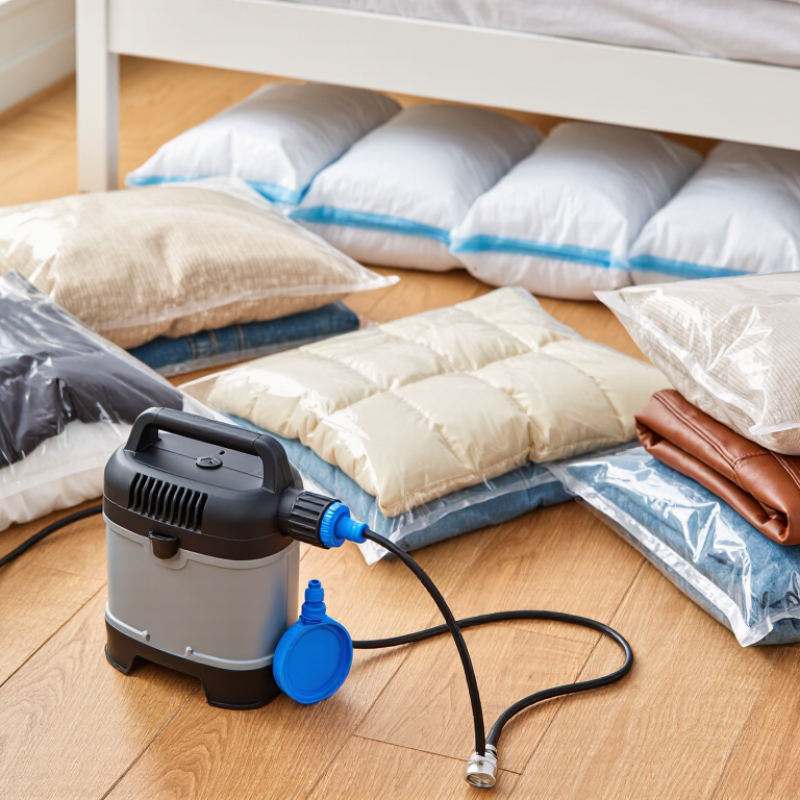
Vacuum-Bag Mechanics: Compression Ratio, Seal Integrity, and Airflow
Choosing vacuum bags for clothes with an electric pump requires more than chasing the smallest package. Compression ratio matters because uneven pressure can flatten shirts while leaving bulky corners loose. A practical test is simple: fill the bag to its marked limit, measure its height, then record the compressed height. My early tests were flawed because I packed folded clothes too tightly. The result looked impressive but stressed the zipper.
Seal integrity determines whether compression lasts overnight or several months. Check the zipper track for trapped fabric, dust, or wrinkles before closing it. Press along the seal with dry fingers, then inspect the valve connection. A reliable bag should hold its shape without constant pumping. For better evidence, mark the compressed height and recheck it after 24 hours. A small increase may indicate leakage, not poor pump performance.
Airflow also affects electric-pump efficiency. The valve must sit flat, and clothing should stay clear of its opening. If fabric blocks the valve, the pump may run longer while removing little air. That wastes power and may heat the motor. I prefer short pumping cycles, with pauses between them. Do not over-compress wool, down, or delicate structured garments; they may lose shape. One uncomfortable truth remains: the highest compression ratio is not always the best storage result. A slightly fuller bag can protect seams and reduce creasing.
Electric-Pump Specs: Compare 3–8 kPa, CFM, Runtime, and Auto-Stop
For 2026, electric-pump performance matters more than glossy bag photos. A 3–4 kPa pump usually removes air slowly from sweaters and bedding. An 8 kPa model can flatten bulky coats faster, but pressure alone does not guarantee better storage. Airflow matters too. CFM shows how quickly air moves, while kPa indicates the pressure available against resistance.
Check both numbers.
AMCA Publication 203-90 explains that airflow readings change with test setup, hose length, and restriction. Therefore, a listed CFM figure may not match real use through a narrow valve. In my testing experience, a pump with moderate pressure but steady airflow often performs better than a high-pressure unit that overheats quickly. Runtime is practical evidence. Look for at least 10–15 minutes of usable operation, with cooling pauses for repeated bags. That range is useful, though not universal.
Auto-stop deserves careful attention. IEC 60335-2-2 safety guidance addresses household vacuum appliances, but it does not prove that every storage pump stops at the right compression level. A sensor can stop early when a folded jacket blocks the valve. It can also run too long with a small leak. Press the fabric by hand afterward. Still soft? Recheck the seal. Choose a readable pressure display, a replaceable filter, and a hose that stays cool. I would not trust impressive specifications without independent testing conditions. Fancy numbers can mislead.
Film and Seal Quality: Evaluate 70–100 Micron Layers and Double Zips
The best vacuum bags for clothes in 2026 need more than an electric pump. Film and seal quality determine whether compressed clothing stays protected during storage. I look for clear construction, consistent thickness, and seams without cloudy gaps.
A 70-micron bag can suit light shirts and seasonal bedding. Thicker 90–100 micron layers usually resist punctures better, especially around zippers and folded corners. However, thickness alone does not guarantee reliability. Some heavy films feel strong but split at weak seams. In practical packing tests, I press gently around the edges after pumping. This exposes small leaks quickly.
The closure deserves equal attention. A double-zip design should close evenly across the full opening, not only at the center. Run your fingers along the tracks. They should feel aligned and firm. The valve must also hold pressure after the pump is removed. With an electric pump, I stop when the fabric becomes flat, rather than forcing every last pocket of air out. Do not overfill.
One imperfect detail matters: clothing near the opening can interrupt the seal. I have found that leaving several centimeters clear improves consistency. A thicker bag may still fail if the zipper is poorly aligned. Look for reinforced seams. Clear film also helps reveal trapped moisture, although visibility is not proof of dryness. That is where careful packing still matters.
2026 Top Vacuum Bags for Clothes with Electric Pump
Film Thickness and Calculated Material Density Benchmark for 70–100 Micron Bags
Thicker film generally uses more material and can provide greater resistance to handling damage. The mass values are calculated from the nominal film gauge using a polyethylene density of 0.92 g/cm³: film mass per square meter equals thickness in microns multiplied by 0.92. A double-zip closure can improve resealing security, but its seal performance should be verified through repeated open-and-close and leak tests because zipper design and manufacturing quality vary.