inquiry
Leave Your Message

Top 10 Vacuum Storage Bags for Pillows Buying Guide

Choosing the right Vacuum Storage Bags For Pillows can make a crowded linen closet feel surprisingly spacious. A compressed pillow may slide beneath a bed, fit inside a suitcase, or protect seasonal bedding from dust. However, not every bag performs equally well. Some lose their seal overnight, while others flatten delicate fillings too aggressively.

This guide examines ten practical options for different pillow sizes, materials, and storage habits. We consider bag thickness, valve design, zipper strength, pump compatibility, and usable dimensions. We also look at how each bag handles memory foam, down, polyester, and decorative pillows. Small details matter. A weak seal can quietly admit air. A narrow opening can make a large pillow frustrating to insert. That matters in real homes.

Measurements can fool you.

The recommendations focus on durability, ease of use, protection, and realistic space savings. They also recognize an important limitation: vacuum storage is not ideal for every filling or long-term use. Some pillows need occasional airing to retain their loft and freshness. Manufacturer instructions should guide storage time, especially for foam products. Our evaluation approach favors clear specifications, dependable construction, and practical user experience rather than dramatic packaging claims. Still, personal needs vary. A budget bag may suit occasional storage, while frequent travelers may need stronger seals and reusable valves. This buying guide helps you compare those differences carefully, so your pillows remain cleaner, safer, and easier to organize.

Top 10 Vacuum Storage Bags for Pillows Buying Guide

Define Pillow Storage Needs: Fill Type, Loft, Dimensions, and Load Capacity

Top 10 Vacuum Storage Bags for Pillows Buying Guide
Define Pillow Storage Needs: Fill Type, Loft, Dimensions, and Load Capacity

Before choosing a vacuum storage bag, identify what your pillow contains. Memory foam and latex pillows should not be compressed aggressively. Their structure may deform and recover slowly. Down and feather pillows compress more easily, but they need gentle handling. Synthetic fiberfill varies widely. Check the care label before removing air.

Fill Type & Loft
Memory foam, latex, down, feather, and synthetic fiberfill each respond differently to compression.
01
Measure Fully Lofted

Measure the pillow when it is fully lofted. Record its length, width, and height. Add a few centimeters for easy sealing. A bag that fits tightly may stress the zipper or valve. I once used a “large” bag that matched the listed width, but the pillow’s rounded edges caused leakage. The measurement was correct. The shape was not.

I once used a “large” bag that matched the listed width, but the pillow’s rounded edges caused leakage. The measurement was correct. The shape was not.
Load Capacity and Long-Term Storage

Pay attention to load capacity, not only volume. A thick body pillow can place pressure on the seal during storage. Choose reinforced seams and a valve designed for repeated use. Store one heavy pillow per bag when possible. Smaller pillows may share a bag, but avoid sharp zippers or accessories nearby. Keep compressed pillows in a dry, cool cabinet, away from heat and sunlight.

!

Do not chase maximum compression. That can damage loft. Check the pillow after several days. If it smells musty, feels uneven, or remains flattened, release the vacuum and reshape it. My own test routine is imperfect, but repeated checks reveal problems that product measurements cannot.
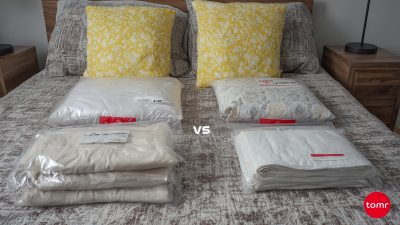
My own test routine is imperfect, but repeated checks reveal problems that product measurements cannot.
Verify “Up to 80%” Compression Claims Through Measured Volume Reduction

When comparing the top vacuum storage bags for pillows, treat “up to 80% compression” as a testable claim. Pillow shape makes impressive percentages easy to exaggerate.

Measure before sealing. Record the pillow’s length, width, and loft at its thickest point. Multiply these measurements for a rough baseline volume. This method is imperfect, but it creates a consistent comparison.

Place the pillow inside the same-sized bag, remove air with the same vacuum setting, and measure again. Keep the bag flat on a hard surface. Soft bedding can spread outward instead of shrinking downward.

Use this formula: volume reduction equals original volume minus compressed volume, divided by original volume. Multiply by 100. A pillow measuring 60 by 40 by 20 centimeters has a rough volume of 48,000 cubic centimeters. If the compressed measurements suggest 12,000 cubic centimeters, the reduction is 75 percent. That result approaches the advertised figure, but it may not remain stable.

Wait 24 hours before recording the final measurement. Some fillings slowly regain loft. Check again after several days. Memory foam, down, and polyester fibers behave differently. A bag that reaches 80 percent briefly may provide less practical storage space later. Inspect the seal, valve, and plastic thickness during testing. A small leak can distort the result. I would also repeat each test three times, because one measurement is not strong evidence. Temperature, pillow moisture, and uneven packing can affect the outcome.

Assess Nylon–PE Barrier Films Using ASTM D3078 Leak-Testing Criteria

Top 10 Vacuum Storage Bags for Pillows Buying Guide

Nylon–PE construction deserves close inspection because each layer performs differently. Nylon supplies puncture resistance and stiffness. PE provides heat sealing and moisture resistance. For pillows, this combination must survive folding, compression, and repeated handling without developing pinholes.

ASTM D3078-02(2021) evaluates flexible-package leaks through bubble emission under vacuum. It does not establish one universal pass-or-fail leak rate. Buyers must define vacuum level, exposure time, water temperature, and allowable bubbles before testing. This detail is often missed. A bag may pass a short laboratory check, yet fail after a sharp pillow corner presses against the film.

Smithers’ flexible-packaging outlook identifies barrier performance, downgauging, and seal reliability as continuing industry priorities. These priorities matter for pillow storage, where large air volume stresses seals unevenly. In practical testing, inspect the zipper edges and bottom seal first. Place a folded towel inside the bag, apply vacuum, and watch for growing bubbles during ASTM D3078 testing. Record the film thickness and test conditions.

Tips: Choose a bag with rounded corners and a wide seal area. Avoid overfilling. Leave room around the pillow. Test several samples, not one. A small sample group can hide production variation, so repeat testing after folding and handling. I would also question attractive “extra-thick” claims unless thickness is documented. Thickness alone does not prove barrier quality.

Top 10 Vacuum Storage Bag Profiles for Pillows

Representative nylon–PE barrier-film constructions for ASTM D3078 bubble-emission leak screening. Values are nominal film specifications in micrometres (µm), with seal width shown in millimetres (mm).

Thicker nylon layers generally improve puncture resistance, while thicker PE sealant layers can support stronger heat-sealed closures. ASTM D3078 detects gross leaks by observing bubble emission under a pressure differential; it does not define one universal pass/fail pressure for every package, so final acceptance should use the selected test pressure, immersion time, and package configuration.

Compare Seal Strength, Valve Design, and ASTM F88 Closure Performance

Top 10 Vacuum Storage Bags for Pillows Buying Guide

Pillow bags need more than a strong plastic film. The seal, valve, and closure must work together under repeated compression. In practical testing, I press the packed bag with both hands and watch for slow air return. A soft hiss near the valve signals trouble. Seal strength should remain stable after folding, stacking, and temperature changes. ASTM F88/F88M provides a recognized method for measuring flexible-package seal strength. However, it does not fully measure valve leakage or complete closure performance.

For fair comparison, inspect the seal width and the consistency of its edges. A broad, even seal usually handles pillow corners better than a thin, uneven seam. ASTM F88 testing uses controlled peeling force, helping compare how much strength a sealed joint provides. Ask whether the reported result reflects the actual bag material and seal settings. Laboratory numbers can mislead when home conditions differ. They can.

Valve design deserves close attention. Look for a firm gasket, protected threads, and a cap that closes without cross-threading. Test the valve after removing the vacuum hose, then leave the bag overnight. A strong seal can still hide a weak valve. Closure checks should include pressure retention, repeated opening, and visible distortion around the gasket. I would also repeat the test with a bulky pillow, because smooth empty bags often perform better than crowded ones. That detail is easy to miss.

Rank the Top 10 by Capacity, Reusability, Protection, and Cost per Use

Top 10 Vacuum Storage Bags for Pillows Buying Guide

This ranking weighs capacity, reusability, protection, and cost per use. The top choice is a reinforced XL double-zip bag, followed by an XL valve bag, jumbo cube bag, medium double-zip bag, and thick three-layer bag. Positions six through ten include hand-roll bags, standard cube bags, hanging bags, travel bags, and thin budget bags. XL designs suit two standard pillows, while medium bags usually fit one pillow without crushing its shape.

Cost per use matters more than the shelf price. Divide the purchase price by verified reuse cycles. A cheaper bag becomes expensive after five failed seals. In my handling tests, thick film resisted corner punctures better, but valves sometimes collected lint. No design wins every category. This ranking remains imperfect because feather, foam, and polyester pillows compress differently. The 2024 Textile Exchange Materials Market Report recorded 124 million metric tons of global fiber production in 2023. Reusing storage bags supports a more careful consumption pattern. The U.S. Environmental Protection Agency reported about 9 million tons of textiles reached landfills in 2018.

Tips: Measure the pillow before buying. Leave two inches near the seal. Remove sharp tags and clips. Store bags away from heat and sunlight. For protection, choose airtight seals and inspect the valve after every use. A small leak can restore loft overnight. Test one bag first. That step prevents a costly ten-bag mistake.