A Storage Logic Mattress Vacuum Bag is a heavy-duty bag designed to hold a mattress while air is removed, reducing its volume for storage or transport. A valve connects to a vacuum cleaner, while a closure helps limit air from returning. The result can be easier to carry through a narrow hallway or fit into a crowded closet. It is not a substitute for careful handling. Mattress Recycling Council estimates that more than 50,000 mattresses and box springs are discarded daily in the United States, underscoring how often bulky bedding must be moved, stored, or replaced.
Vacuum compression can save space, but it does not make every mattress suitable for long-term compression. Foam, construction, storage time, and manufacturer guidance all matter. A damp mattress sealed in plastic may retain moisture, so the mattress should be completely dry before packing. The U.S. Environmental Protection Agency’s 2018 materials report found that Americans generated 17 million tons of textile waste, though that figure covers textiles broadly and is not mattress-specific. That distinction matters. A storage bag can help protect bedding from dust during a move, but it cannot guarantee protection from moisture or damage. Check the bag’s dimensions, seal, and valve, and follow the mattress maker’s storage instructions. Compression is useful, not magic.
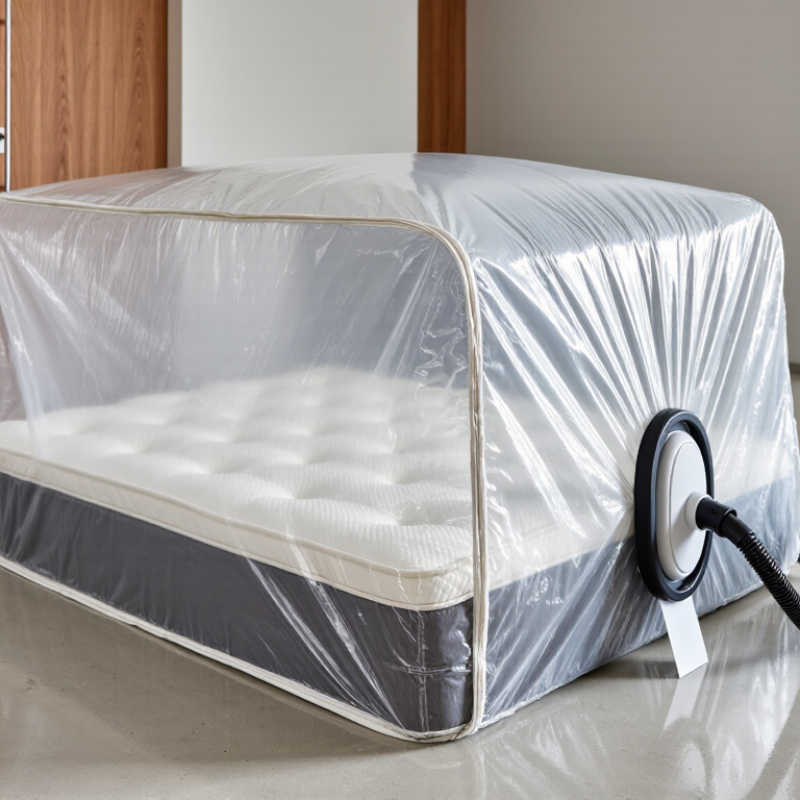
A mattress vacuum storage bag is a thick plastic sleeve with a closable opening and an air valve. Its purpose is to reduce a mattress’s bulk for temporary storage or transport. A vacuum removes air from the bag, compressing the mattress so it takes up less space. Less bulky, not weightless.
The bag also helps shield the mattress from dust, spills, and handling marks. It is not a substitute for a dry, clean storage area, and a puncture can let air and moisture in. Grand View Research estimated the global mattress market at USD 50.61 billion in 2022. That figure reflects the scale of the mattress industry, but it does not measure vacuum-bag performance or prove that compression extends mattress life.
Before sealing the bag, make sure the mattress is fully dry and check its care instructions. Some foam mattresses can be damaged by prolonged compression or folding. Keep the bag away from sharp edges, and inspect the valve and seams after removing air. A slow leak is easy to miss. The bag is best treated as a practical space-saving cover, not long-term climate control.

A mattress vacuum bag is a durable cover that lets air be removed from a compatible mattress to reduce its packed volume for storage or transport. The chart compares the surface areas of common U.S. mattress sizes; it does not represent compressed volume.
Purpose: By limiting exposure to dust and moisture while helping reduce the space a compatible mattress occupies, a vacuum bag can make temporary storage and moving more manageable. Always check the mattress maker’s care instructions before compressing a mattress.
A storage logic mattress vacuum bag is usually built from a wide, flexible film sleeve, a closure track, and an air valve. The sleeve often combines polyethylene for flexibility with a tougher nylon layer that helps resist punctures. Exact film thickness and layer structure vary, so the product specifications matter. The plastic should feel smooth, not brittle, when opened at room temperature.
The closure track presses the two edges together to limit air leaks. Some designs use a sliding clip; others need careful finger pressure along the full seam. A valve with a screw cap or plug connects to a household vacuum hose and helps keep air from returning. Check that its gasket sits flat. Small wrinkles can interfere.
Reinforced seams help support the bag as air leaves, but they cannot make it immune to sharp bed-frame corners. A cloth or cardboard barrier underneath can reduce rubbing. Avoid forcing a mattress into a bag that is too small, and follow the mattress maker’s guidance on compression time. Foam may not fully regain its shape after prolonged compression. That part is easy to overlook. The materials list alone cannot confirm durability; seal quality and careful handling matter too.
A storage-logic mattress vacuum bag removes air to reduce a mattress’s shipping or storage volume. It does not make the mattress lighter. If the mattress can be rolled or folded, place it inside the bag, seal the opening, and use a pump to draw out air. Air moves out. As pressure inside falls, outside air pressure pushes the bag against the mattress layers. A valve helps keep air from returning. Even a small leak can let the roll loosen over time.
Compression is not simply a matter of vacuuming harder. ASTM International’s D3574 standard describes tests for flexible cellular urethane foam, including compression-related properties. It is a technical reference, not a guarantee that every mattress can be compressed safely. Foam density, springs, and adhesives can respond differently. Follow the mattress maker’s limits for rolling, compression time, and expansion. Grand View Research estimated the global mattress market at USD 50.61 billion in 2023; that figure reflects a broad industry, not any one mattress’s tolerance for compression. After opening the bag, allow the mattress to expand in a ventilated room and check its shape and seams. The timing guidance can feel fussy, but guessing is not ideal.
A storage logic mattress vacuum bag is a heavy plastic cover with a valve that lets you remove air around a mattress. Less trapped air can make the mattress easier to carry through a narrow hallway or fit into a storage area. It also helps shield the mattress from dust and minor spills if the seal stays intact. Check that the mattress is completely dry before packing it. Even a little moisture can cause trouble inside sealed plastic. Keep the valve clean and use a pump suited to the bag.
Compression has limits. Some foam mattresses are designed to be compressed for shipping, but that does not mean every model is suitable for months in a vacuum bag. Follow the mattress maker’s storage guidance, especially for latex, hybrid, or older mattresses. Tight compression may crease fabric, stress seams, or affect how foam regains its shape. Store the bag flat, away from heat, sharp edges, and heavy objects. Check it occasionally for leaks. It is less convenient than it sounds: a small puncture can let air back in, and a compressed mattress may still be awkward to move. I would not treat vacuum storage as a permanent fix for limited space.
What Is a Storage Logic Mattress Vacuum Bag? Selection, Use, and Care Guidelines
A storage logic mattress vacuum bag is designed to reduce a mattress’s bulk for temporary storage or moving. Choose one that matches the mattress dimensions, with enough room to load it without forcing the edges. Check the film thickness, closure quality, and valve design; a weak seal can let air back in. Read the mattress care instructions before compressing it. Some foam and hybrid mattresses may be damaged by prolonged or deep compression. Bigger is not always better.
Start with a clean, completely dry mattress. Slide it into the bag carefully, keeping fabric away from the zipper track and valve. Close the seal fully, then connect a compatible vacuum and remove air gradually. Stop when the bag is snug, not rock-hard. I’ve found that rushing this step can wrinkle the bag around corners. It is easy to miss one.
Store the packed mattress in a cool, dry place, preferably flat and away from sharp objects or heavy items. Avoid damp basements and hot sheds, where moisture or heat may affect the mattress and bag. Before reuse, inspect the seal and valve for cracks, and wipe the bag with a soft, damp cloth. Let the mattress expand in a well-ventilated room, following its care guidance. The recovery time can vary, so patience matters.
| Topic | Guideline | Practical Check |
|---|---|---|
| What it is | A mattress vacuum bag is a large, airtight storage bag designed to reduce the volume of a mattress by removing air. It is commonly used for moving or temporary storage. | Confirm that the bag is intended for mattresses, not just clothing or bedding. |
| Measure before buying | Measure the mattress length, width, and thickness. Bag dimensions and compatible mattress sizes vary, so compare the measurements rather than relying on a size label alone. | Allow enough room to insert the mattress and close the seal without stretching or straining it. |
| Mattress compatibility | Foam and many hybrid mattresses may be compressible, but compatibility depends on the mattress construction and manufacturer instructions. Innerspring mattresses generally should not be compressed unless specifically approved. | Check the mattress care label or manufacturer guidance before vacuum packing. Do not assume every mattress can be compressed. |
| Bag construction | Look for durable, puncture-resistant plastic, a secure closure, and a valve that fits the vacuum hose or included pump. Material thickness and valve design differ between products. | Inspect seams, the closure track, and the valve for damage before use. |
| Prepare the mattress | Make sure the mattress is completely dry and free of loose debris. Remove bedding and accessories, and avoid packing a damp mattress, which can encourage mold or mildew during storage. | Allow recently cleaned or aired bedding to dry fully before sealing. |
| Pack and seal | Slide the mattress into the bag carefully, keeping sharp objects away from the plastic. Close the seal completely, then remove air gradually according to the bag instructions. | Do not over-compress. Stop if the mattress or bag shows signs of unusual strain. |
| Storage conditions | Store the sealed mattress in a clean, dry place away from direct sunlight, heat sources, sharp edges, and pests. Avoid placing heavy items on top. | For long-term storage, follow the mattress maker’s guidance on whether the mattress should remain flat or be stored in another position. |
| Care and reuse | After use, clean the bag according to its care instructions and let it dry completely before folding. Store it away from sharp objects and excessive heat. | Replace a bag with a damaged seam, faulty closure, or leaking valve; these can prevent an airtight seal. |
| Unpacking | Open the valve or closure carefully and let the mattress expand in a well-ventilated area. Recovery time varies with mattress materials and how long it was compressed. | Allow the mattress time to regain its shape before use, and contact its manufacturer if it does not recover as expected. |
| Important limitation | Vacuum bags reduce bulk but do not make a mattress waterproof, protect it from every impact, or guarantee indefinite preservation. | Use additional protective wrapping for moving, and check the storage area periodically for moisture or damage. |